Table of Contents
Introduction
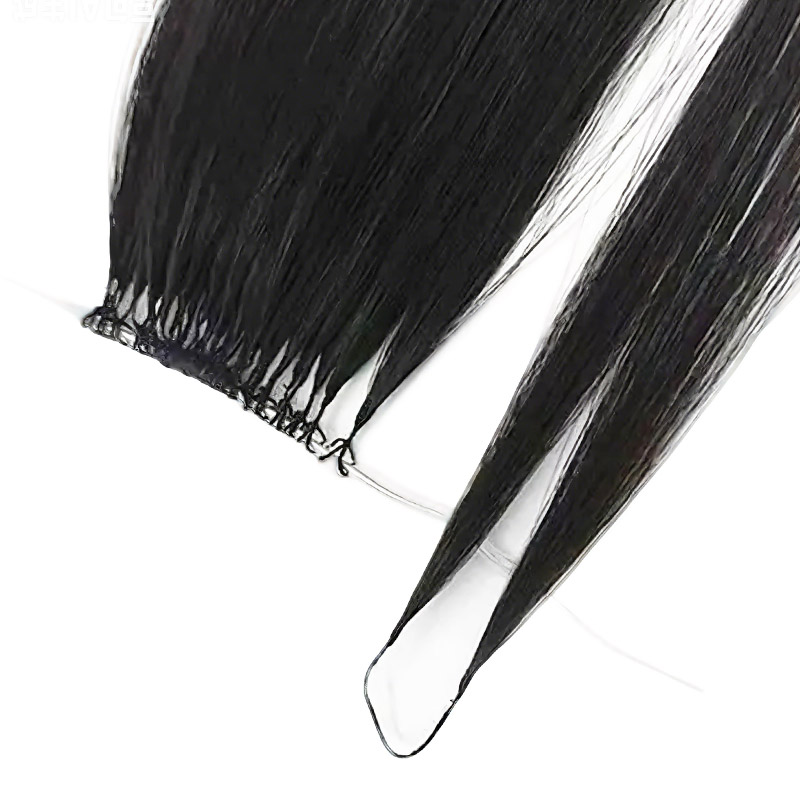
Feather hair extensions are designed for people who want additional length, volume, dimension, or carefully placed color without relying on one wide attachment row. Each extension section is installed separately, giving the stylist more control over where hair is added and how the final density is distributed.
This individual-strand structure is the main reason feather hair can create a light and flexible result. Instead of placing the same amount of hair across an entire section, the stylist can add more strands where support is needed and fewer strands around delicate or highly visible areas.
However, a thin attachment alone does not guarantee a natural result. The extension hair must match the natural hair, the connector must carry an appropriate amount of weight, and the final length must blend gradually into the existing haircut.
A successful feather hair installation depends on three connected elements:
- Fiber compatibility
- Installation balance
- Transition quality
These elements form a practical FIT framework for evaluating feather hair. Fiber compatibility considers how well the extension hair matches the natural hair. Installation balance focuses on weight, tension, and placement. Transition quality evaluates whether the color, texture, density, and length blend naturally.
When all three elements work together, feather hair can move freely, remain discreet, and support a wide range of hairstyles.
What Are Feather Hair Extensions?
Feather hair generally refers to an individual-strand extension system with a fine, tapered, flat, or low-profile attachment point. The term describes the light construction of the tip rather than a specific hair texture.
The wider category of hair extension integration methods includes individual tips, rings, bonded strands, tapes, wefts, clips, and other attachment structures. Feather hair belongs primarily to the individual-strand category because each extension section can be positioned separately.
The Structure of a Feather Tip
A feather hair extension has two functional areas.
The lower section contains the visible hair fibers. This part determines the length, texture, color, density, and movement of the extension.
The upper section forms the connector. Depending on the product design, the connector may be shaped into a narrow line, small tip, flexible tab, double strand, or tapered attachment.
A well-constructed feather tip should:
- Hold the extension strands securely
- Remain narrow enough for discreet placement
- Flex during normal head movement
- Carry an appropriate amount of hair
- Maintain its shape during installation and maintenance
The best attachment is not always the smallest one. A connector that is extremely narrow but carries too much extension hair may place excessive stress on a small natural section.
How Individual-Strand Extensions Work
Each feather hair strand is attached to a controlled section of natural hair. Because the strands are installed individually, their position, direction, density, and color can be adjusted separately.
This allows a stylist to build a customized result rather than following one fixed row pattern. Individual placement may be used to:
- Increase length through the back
- Add fullness around the sides
- Support internal layers
- Introduce lowlights or highlights
- Fill selected areas
- Improve the shape of shorter styles
Feather Hair vs Decorative Feathers
Feather hair extensions are different from decorative feather accessories.
Decorative feathers are ornamental pieces placed in the hair for color or texture. Feather hair extensions are made from extension fibers and are intended to blend with natural hair.
Clear terminology is important because a person searching for feather hair may be looking for either a decorative accessory or an individual-strand extension system. Product pages and blog content should explain the material, attachment type, and intended application clearly.
Why Feather Hair Creates Natural-Looking Volume
The natural appearance of feather hair comes from controlled distribution rather than simply adding more hair.
Individual Density Control
Natural hair does not have identical density in every area. The back may be fuller, while the sides, temples, and perimeter may be lighter.
Individual feather hair strands allow the stylist to reproduce this natural variation. More strands can be used in stronger areas, while lighter placement can protect delicate zones and maintain a believable shape.
This prevents the installation from appearing equally dense from the crown to the ends.
Lightweight Weight Distribution
A continuous extension row concentrates weight along one section. Feather hair distributes that weight across multiple attachment points.
Distributed weight can support greater styling flexibility when each natural section is strong enough for the attached strand. However, distribution is only beneficial when the section sizes are consistent and the extension strands are not overloaded.
The goal is balanced weight, not simply a high number of attachments.
Independent Strand Movement
Individual strands can move separately when the wearer turns, brushes, or styles the hair. This independent movement can resemble the behavior of natural hair more closely than a rigid attachment structure.
Movement depends on connector flexibility and correct placement. A stiff connector or incorrectly angled strand may lift away from the head or move against the surrounding hair.
Targeted Length and Volume Placement
Feather hair does not need to be installed evenly across the entire head. It can be concentrated where the hairstyle needs support.
For example, a stylist may use stronger placement through the lower back to create length while using fewer strands around the sides to soften the transition. This targeted approach can improve the shape without creating unnecessary bulk.
Main Types of Feather Hair Extensions
Feather hair is available in several attachment designs. Product names may vary, so the physical construction should always be inspected before selecting an installation method.
Micro Ring Feather Hair
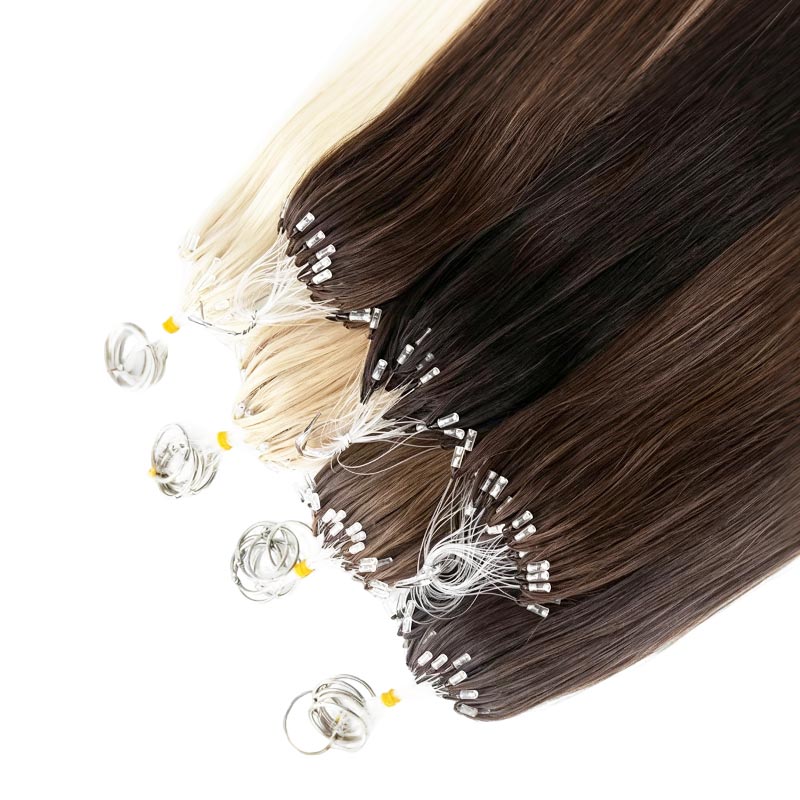
Micro ring feather hair uses a small ring or bead to secure the extension strand to natural hair. The method does not require the connector itself to be melted during installation.
The ring must match the size of the natural section and the extension tip. A ring that is too large may slip, while one that is too small may compress the hair excessively.
Professional feather tip micro ring hair extensions can support detailed strand placement, color blending, and controlled volume when the sectioning and attachment tension are properly managed.
Invisible Feather Tip Extensions
Invisible feather tips use a narrow or flattened attachment designed to reduce the visible profile beneath natural hair.
The word “invisible” should not be interpreted literally. The attachment can still become visible when it is placed too close to a parting, installed beneath insufficient coverage, or loaded with too much extension hair.
Flat Feather Line Extensions
Flat feather line extensions use a thin, elongated connector rather than a rounded tip. The flat profile can sit closer to the head and distribute the strand across a slightly wider natural section.
This design may help reduce a raised attachment profile, but the line must follow the natural direction of the hair.
Bonded Feather Tips
Bonded feather tips use a preformed attachment material that is softened or activated during professional installation.
The bond should remain compact and smooth after application. A bulky or irregular bond may catch during brushing, become visible, or create uneven movement.
The material, installation temperature, section size, and technician technique all affect the final result.
Human Hair and Synthetic Feather Hair
Human hair feather extensions generally provide greater flexibility for washing, styling, blending, and texture matching. Their performance still depends on processing history, cuticle condition, and fiber quality.
Synthetic feather hair may retain a preset shape but can react differently to heat, friction, and styling products. The care routine must follow the fiber specifications rather than assuming that every extension behaves like natural hair.
The FIT Framework for Evaluating Feather Hair
The FIT framework provides a practical method for evaluating feather hair before installation.
| FIT element | Main question | What to inspect | Risk when ignored |
|---|---|---|---|
| Fiber compatibility | Does the extension behave like the natural hair? | Strand diameter, texture, color, movement and condition | Difficult blending and excessive styling |
| Installation balance | Is the weight distributed safely and discreetly? | Connector size, section strength, placement and tension | Slipping, discomfort or visible attachments |
| Transition quality | Does the result change gradually from natural hair to extension hair? | Density, length, layers, color and perimeter blending | A shelf-like or artificial appearance |
Fiber Compatibility
Fiber compatibility means more than matching one color swatch.
The extension should also match the natural hair’s:
- Strand thickness
- Surface texture
- Curl or wave pattern
- Movement
- Density
- Response to humidity
- Response to heat styling
A straight extension may appear compatible when both the natural hair and extension are styled. After washing, however, different natural patterns can create a noticeable separation.
Installation Balance
Installation balance refers to the relationship between extension weight and natural hair strength.
A successful attachment should be secure without restricting normal movement. The natural section should contain enough healthy strands to support the extension, but it should not be so large that the connector slips.
Balance also includes placement. Attachments should be distributed in a pattern that supports the hairstyle without overcrowding one area.
Transition Quality
Transition quality determines whether the extensions appear to belong to the same head of hair.
A strong transition usually includes:
- Gradual changes in length
- Controlled differences in density
- Related color tones
- Compatible textures
- Soft perimeter placement
- A haircut that connects the natural and extension layers
The final result should be evaluated from the front, sides, back, and during movement.
Feather Hair Extension Comparison
| Extension type | Attachment profile | Placement control | Natural movement | Main consideration | Suitable use |
| Micro ring feather hair | Small individual ring | High | High | Ring size and section strength | Targeted volume and reusable placement |
| Invisible feather tip | Narrow or flat individual tip | High | High | Requires sufficient natural coverage | Discreet internal placement |
| Bonded feather tip | Compact preformed bond | High | High | Bond formation and removal technique | Detailed length and color placement |
| Tape-in extensions | Flat adhesive sections | Medium | Medium | Requires clean, balanced panels | Distributed volume across wider sections |
| Weft extensions | Continuous track | Medium | Medium to high | Row position and track thickness | Structured coverage and fuller rows |
No extension method is universally suitable for every person. The best option depends on natural density, desired result, maintenance habits, styling routine, and the condition of the scalp and hair.
How to Choose Feather Hair for Different Hair Types
Product selection should begin with the natural hair rather than the desired extension length.
Feather Hair for Fine Hair
Fine hair usually benefits from lightweight strands, narrow connectors, and conservative density.
The stylist should avoid placing attachments too close to visible partings or fragile perimeter areas. Using more small strands is not automatically safer; each section must still contain enough natural hair to support the extension.
A lightweight result depends on the total installed weight as well as the size of each connector.
Feather Hair for Thick Hair
Thick hair can often conceal a wider range of attachment profiles. However, it may require more extension density to create a smooth transition through the ends.
The stylist should evaluate the natural haircut carefully. Thick, blunt ends can create a visible shelf above longer extension hair unless the density and layering are blended correctly.
Feather Hair for Short Hair
Short hair requires careful placement because the natural layers may not provide enough coverage over the connectors.
The most successful transformations usually preserve enough natural length around the crown and sides to hide the attachments. The extension length should also increase gradually rather than creating an abrupt change.
Feather Hair for Straight, Wavy, and Curly Textures
Texture matching should consider more than a general category.
For wavy and curly hair, examine:
- Pattern size
- Pattern direction
- Root shape
- Strand diameter
- Definition after washing
- Expansion during drying
For straight hair, inspect surface smoothness, body, and natural movement. Two straight textures can behave differently when exposed to humidity or heat.
Feather Hair for Sensitive Scalps
People with sensitive scalps require conservative weight, careful sectioning, and flexible attachment placement.
The installation should not create persistent pulling, burning, or concentrated pressure. Comfort should be evaluated during the appointment and after the strands have been moved in several directions.
How Feather Hair Extensions Are Installed
Professional installation involves assessment, planning, attachment, testing, and blending.
Hair and Scalp Assessment
The stylist should examine the density, elasticity, breakage, scalp condition, growth direction, and existing haircut before selecting an attachment pattern.
Weak or irritated areas should not be treated as ordinary installation zones. Adding extension weight to compromised natural hair can worsen the problem.
Section Planning
Section planning determines where every attachment will sit.
The stylist should identify:
- Visible partings
- Crown movement
- Hairline boundaries
- Fragile temple areas
- Strong internal sections
- Final styling directions
The attachment pattern should support the wearer’s usual hairstyles, not just the finished salon look.
Strand Attachment
Each natural section should be clean, controlled, and proportionate to the extension strand.
For ring-based systems, the natural and extension hair are positioned inside the connector before it is secured. For bonded systems, the attachment is shaped around the natural section according to the product method.
Connections should remain separated from neighboring strands.
Tension Testing
After attachment, the strand should move in the direction of the surrounding hair without pulling the scalp.
The stylist can test movement by gently lifting, turning, and lowering each installed section. Painful resistance, twisting, or lifting may indicate incorrect direction or excessive tension.
Cutting and Blending
The natural hair and extensions should be cut as one combined hairstyle.
Blending may involve internal layering, perimeter softening, controlled point cutting, or shape adjustment. The technique should respect the natural texture and the wearer’s daily styling routine.
How to Make Feather Hair Look Natural
The most natural result is usually created through a series of small decisions rather than one dramatic technique.
Match Multiple Hair Tones
Natural hair often contains different tones through the roots, surface layers, mid-lengths, and ends.
Using one flat shade may create a block of color. A combination of related tones can reproduce natural dimension and help individual feather hair strands disappear into the surrounding hair.
Match Strand Diameter
Color and texture may appear correct while the extension strand diameter remains noticeably different.
Very coarse extension hair can look heavy beside naturally fine hair. Extremely fine extension fibers may not create enough density beside thick natural strands.
Matching strand diameter improves both visual blending and movement.
Create a Gradual Density Transition
Density should move gradually from the natural root area into the extension length.
If the lower extension section is much fuller than the natural hair above it, the result may appear disconnected. If too little extension hair is used, the natural ends may remain visible as a separate layer.
Protect the Hairline and Parting Areas
The hairline, temples, crown, and partings are highly visible and often more delicate.
Attachments should remain far enough from these areas to preserve coverage during movement. Lighter color pieces can also become more visible near the root, so color placement should account for contrast.
Blend the Extensions Into the Final Haircut
A natural blend should work during ordinary movement, not only in one styled position.
The haircut should connect the shortest natural layers with the longest extension sections. The final shape should be checked with the hair down, moved to each side, and arranged in common everyday styles.
How to Care for Feather Hair Extensions
Care should protect the hair fibers, connector, scalp, and natural sections supporting the extensions.
Washing the Hair and Scalp
Detangle the hair before washing. Wet the hair in a downward direction and cleanse the scalp with controlled finger movements.
Avoid rough circular rubbing around the attachments. This motion can twist neighboring strands together and contribute to root tangling.
Rinse thoroughly because product residue can collect around small connectors.
Conditioning the Mid-Lengths and Ends
Apply conditioner mainly through the mid-lengths and ends.
Heavy conditioning products placed directly on certain attachment types may contribute to buildup or slipping. The product should be distributed carefully rather than applied heavily across the roots.
Drying the Attachment Area
The attachment area should be dried completely.
Separate the strands so airflow can reach between the connectors. Use controlled heat and avoid holding a dryer too close to one point.
A damp root area can make the strands difficult to separate and may contribute to tangling or discomfort.
Brushing and Detangling
Support the hair near the attachments and begin brushing from the ends. Move upward after the lower tangles have been removed.
Use a brush suitable for individual extensions. Avoid pulling the brush directly across connectors or forcing it through a resistant section.
Heat Styling
Human hair feather extensions can generally be curled or straightened when the fiber condition permits it.
Use moderate heat, apply an appropriate protective product, and avoid direct contact between hot tools and the attachment. Repeated high heat can gradually weaken the ends even when the hair initially appears healthy.
Sleeping and Daily Protection
The hair should be dry and detangled before sleeping. A loose braid or controlled low style can reduce friction and limit free movement across bedding.
During exercise or other high-movement activities, secure the lengths without pulling tightly against the connectors.
Common Feather Hair Problems and Solutions
Problems should be diagnosed by examining the product, installation, natural hair, and care routine together.
Visible Attachments
Connectors may become visible when they are:
- Placed too close to a parting
- Installed beneath insufficient natural coverage
- Too large for the surrounding hair
- Positioned against the natural growth direction
- Installed with excessive density
The solution may require repositioning rather than simply covering the connector with more hair.
Slipping Strands
Slipping may result from an incorrectly sized connector, insufficient natural hair inside the attachment, product buildup, or poor compression.
Repeated slipping should not be corrected by applying excessive pressure. The connector and section size should be reassessed.
Root Tangling
Natural hair sheds as part of its normal cycle. When shed strands remain trapped near extension attachments, they can combine with neighboring hair.
Regular separation and maintenance help prevent these strands from forming compact tangles near the roots.
Dry or Rough Ends
Extension hair does not receive natural scalp oils in the same way as growing hair.
Dryness may result from heat exposure, harsh washing, friction, previous processing, or insufficient conditioning. Applying heavy products without removing buildup may coat the hair without improving its condition.
Uneven Density
Uneven density can develop when too many strands are installed in one area or when extension weight is not matched to the natural haircut.
The stylist should evaluate the hairstyle as a complete shape rather than focusing only on the number of installed strands.
Scalp Discomfort
Persistent pain, burning, pulling, or irritation should not be treated as a normal part of wearing feather hair.
The row direction, connector weight, section size, placement, and scalp condition should be assessed by a qualified professional.
How Long Feather Hair Extensions Last
There is no single lifespan that applies to every feather hair product or wearer.
Longevity is influenced by:
- Hair fiber quality
- Cuticle condition
- Previous processing
- Connector durability
- Installation technique
- Heat styling frequency
- Washing habits
- Daily friction
- Maintenance timing
Product lifespan and installation cycle are different concepts.
The product lifespan describes how long the extension hair remains suitable for use. The installation cycle describes how long the current attachments can remain in place before growth and movement require professional adjustment.
Factors That Affect Reusability
Feather hair may remain suitable for reuse when:
- The strands remain smooth after washing
- The ends retain sufficient strength
- The connector remains intact
- The hair can still be separated easily
- The texture remains consistent
- The color remains stable
- The strands do not shed excessively
Signs Maintenance Is Required
Maintenance may be needed when:
- Attachments have moved away from the scalp
- Strands begin rotating
- Root tangles become difficult to separate
- Connectors become more visible
- The hairstyle becomes uneven
- Brushing near the roots becomes difficult
Signs Replacement May Be Necessary
Replacement may be appropriate when the extension hair has severe breakage, persistent tangling, weakened ends, damaged connectors, or an altered texture that no longer responds to careful conditioning.
Reusing unsuitable strands can reduce the quality of the next installation.
How to Evaluate Feather Hair Quality
Initial softness is only one part of quality evaluation.
Hair Fiber Condition
Inspect the upper length, middle section, and ends. Look for excessive dryness, split fibers, uneven thickness, and weak areas.
Gentle tension can reveal whether the fibers stretch normally or break easily.
Cuticle Alignment
Consistent root-to-tip alignment helps reduce friction between strands.
Alignment should be evaluated after washing because surface treatments may temporarily make misaligned hair feel smoother.
Attachment Consistency
Connectors should have controlled dimensions and hold a consistent amount of hair.
Irregular tips can produce uneven attachment weight and make professional installation more difficult.
Strand Weight Uniformity
Strands intended for the same installation should have similar density unless they are specifically designed for different placement zones.
Unexpected variation can create uneven fullness and inconsistent tension.
Color and Texture Accuracy
Colors should be evaluated under consistent lighting. Wavy and curly textures should be washed and dried to observe pattern recovery.
Texture labels alone cannot show how the hair will behave after cleansing.
Performance After Washing
A professional sample assessment should include:
- Wet detangling
- Dry brushing
- Natural drying or controlled drying
- Texture recovery
- Strand-loss observation
- End-condition inspection
- Heat-styling response
This testing provides more useful information than judging the product directly from its packaging.
Feather Hair for Salons and Hair Brands
Professional users need consistency across repeated orders, not only one attractive sample.
Sample Testing
A sample should be washed, dried, brushed, styled, and documented before approval.
The evaluation should record color, texture, length, strand density, connector dimensions, and performance after care.
Product Specification Control
Terms such as feather tip, invisible tip, or flat line may describe different structures across product collections.
A clear specification should identify:
- Hair material
- Strand length
- Texture
- Color
- Connector design
- Strand density
- Intended installation method
- Packaging requirements
Color and Texture Reproducibility
Returning clients and established product collections require repeatable shades and textures.
Physical references, controlled photographs, shade codes, and approved samples can reduce variation between production batches.
Customization Requirements
Professional projects may require adjustments to strand weight, color distribution, length, texture, connector shape, labeling, or packaging.
These details should be confirmed before production. Salons and brands can communicate their custom feather hair specifications according to the intended attachment method, target client group, color system, and styling requirements.
Quality-Control Communication
Quality control is more reliable when expectations are documented.
An approved reference sample, written specifications, consistent inspection methods, and clear reporting can help prevent misunderstandings during repeated production.
Conclusion
Feather hair extensions create natural-looking volume by distributing individual strands across carefully selected areas. Their lightweight appearance comes from controlled density, flexible movement, compatible fibers, and gradual blending rather than from connector size alone.
The FIT framework provides a useful way to evaluate the result. Fiber compatibility determines how the extension behaves beside natural hair. Installation balance controls weight and tension. Transition quality connects the color, texture, length, and density.
When the product is matched correctly, installed professionally, and maintained consistently, feather hair can support flexible styling without creating an unnecessarily heavy or obvious result.
FAQ
What is feather hair?
Feather hair is an individual-strand extension system with a fine, tapered, or low-profile attachment. The strands can be placed separately to add targeted length, fullness, or color. It should not be confused with decorative feathers used as temporary hair accessories.
Is feather hair suitable for fine hair?
Feather hair may suit fine hair when lightweight strands, small connectors, and conservative density are used. The stylist must avoid fragile areas and ensure each natural section can safely support the extension. A thin attachment alone does not guarantee suitability.
Can feather hair extensions be reused?
Some feather hair extensions can be reused when the hair remains manageable and the connector is designed for reinstallation. Reusability depends on fiber condition, attachment type, removal technique, heat exposure, maintenance, and whether the strands remain consistent after washing.
Can feather hair be curled or straightened?
Human feather hair can generally be curled or straightened with controlled heat. A heat-protective product should be used, and hot tools should not touch the connector. The appropriate temperature depends on the hair’s condition and processing history.
How often does feather hair need maintenance?
Maintenance timing varies with natural hair growth, attachment type, strand placement, and daily care. Professional attention may be needed when the attachments move away from the scalp, rotate, become visible, or develop trapped shed hair near the roots.